
Returning a Benin Bronze to its rightful place: Benin City
In 2021, the University of Aberdeen returned a looted Benin Bronze from their collection to the Oba of Benin, becoming the first UK institution to agree to an unconditional return of a Benin Bronze. Neil Curtis, from University of Aberdeen, outlines the process of giving back a pillaged object without a repatriation request being made.
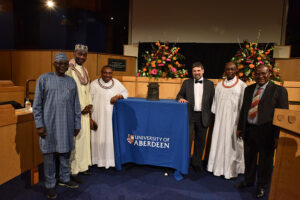
The Benin Bronze is returned during a ceremony in Aberdeen. Image credit – Copyright of University of Aberdeen.
(L-R) Professor Abba Isa Tijani (National Commission for Museums and Monuments, Nigeria), Prince Isa Bayero (Emirate of Kano), Chief Charles Uwensuyi-Edosomwan (Kingdom of Benin), Neil Curtis (University of Aberdeen), Prince Aghatise Erediauwa (Kingdom of Benin), His Excellency Suleiman Sani (Nigeria High Commission)
Return (And Other) Stories is a series of stories which aim to make the ideas and processes of Restitution and Repatriation more accessible to museum workers and those interested in the topic.
Repatriation is a crucial part of decolonising initiatives and a clear way in which we can actively lead change, consider and reimagine the role of museums and galleries in understanding and addressing legacies of Colonialism, Slavery and Empire.
Content Warning: This article discusses the violent destruction and killing in Benin City by British troops in 1987.

Introduction
Returning a Benin Bronze to the Oba of Benin from the University of Aberdeen Collections.
For many centuries, copper-alloy casting in Benin City has been used to commemorate the lives of the Obas (kings/heads of state) and other significant features of the Edo people’s history. In 1897, in the so-called ‘Benin Punitive Expedition’, British troops attacked Benin city, killing thousands of people. The soldiers ransacked the Oba’s palace, looted thousands of items of great cultural and religious importance including the ‘Benin Bronzes’, and forced the Oba into exile.
In the early 20th century the Benin Bronzes became of significant interest across Europe as part of a growing interest in African Art. As a consequence, the ‘Benin Bronzes’ now feature in the collections of most major museums across Europe and North America. Since the 1930s, there have been attempts by generations of Obas and others in Nigeria to retrieve them, with the collection of almost 1000 in the British Museum a particular focus of campaigns.
In 1957, the University of Aberdeen purchased for its museum collection at auction a ‘Benin Bronze’ depicting the head of an Oba. This was unusual, as most of the University’s museum collections had been donated by former graduates who made collections as part of their colonial activities in roles such as administrators, missionaries, soldiers and doctors, rather than the institution making purchases. While ongoing research is revealing the complexities, and often injustices, of such collecting practices, the looting of Benin City stands out as a particularly violent and reprehensible example.
How the return came about
Although the University’s Benin Bronze was known about for 20 years, no specific return claim was made before 2020, despite ongoing public debate about repatriation. Due to its history of successful repatriations, University of Aberdeen Collections chose not to join the Benin Dialogue Group, which focused on loans rather than returns. Instead, we decided to investigate whether an outright return would be possible. Although the original provenance of the Benin Bronze was clear, research was carried out by Alex Tweedie of Lyon & Turnbull to establish its history after 1897. However, staff from the University’s museum had to identify how the return could be arranged, and who the appropriate recipients in Nigeria would be.
Fortunately, through Jos van Beurden, author of ‘Treasures in Trusted Hands – Negotiating the future of Colonial Cultural Objects’, we were able to contact Professor Bankole Sodipo, a Nigerian lawyer with good contacts in Nigeria. Professor Sodipo was able to contact the relevant people in the Royal Court, the state government, the federal government and the national museums in Nigeria. This led to a formal claim by the Nigerian Federal Ministry of Information and Culture, with messages of support from all the other parties.
The University’s repatriation procedure was followed and an advisory panel was established. The panel included members of the University and its museums, a representative of another Scottish museum (Steph Scholten of The Hunterian), and a nominee of the proposed recipient (Professor Bankole Sodipo). The panel unanimously recommended the unconditional return of the Benin Bronze. This decision was supported by the University’s senior management team before final approval by the governing body, the University of Aberdeen Court, in October 2021.
The return process
In late 2021, a ceremony was held in Aberdeen where the Bronze was handed to representatives of the National Museums and Monuments Commission of Nigeria, and the Nigerian High Commission, in the presence of Prince Aghatise Erediauwa, the brother of Oba Ewuare II. Following the ceremony, the Nigerian High Commission arranged for its transport, including export licensing, back to Nigeria.
Finally, in February 2022, exactly 125 years to the day after it had been looted it was handed to Oba Ewuare II in the royal palace in Benin City.
Speaking to Nigerian television service, Channels Television, His Royal Majesty, Oba of Benin, Omo N’Oba N’Edo Uku Akpolokpolo, Ewuare II is quoted:
Much has been said about the significance of heritage art and, in spite of the occasional attempts in some quarters to downplay their cultural and religious relevance, these works are often imbued with the spirit of the people from whom they were taken. [...], we thank the University of Aberdeen for this noble act of returning our bronze work. We hope that other institutions worldwide will see the injustice when they insist on holding on to items which in fact should be a reminder to them of the great injustice that was inflicted on a people so far away and so long ago.
His Royal Majesty, Oba of Benin, Omo N’Oba N’Edo Uku Akpolokpolo, Ewuare II
Although often seen as the first museum-led repatriation of a Benin Bronze, it was a significant collaborative effort between the Court of the Oba and Nigeria’s federal government to enable more returns. Their process of working together helped develop a pathway for the substantial return of the Benin Bronzes to their ownership and care. This high-profile repatriation generated substantial international media interest. Careful planning went into managing media relations, focusing the story on truth-telling and returning stolen property.
Professor Abba Isa Tijani, Director-General of the National Commission for Museums and Monuments, commented following the ceremony to Channels Television “We earnestly expect without any doubt that other persons and institutions will reach out to us for talks on the way forward concerning Nigerian artefacts in their possession. The Aberdeen return should inspire all to a future of friendly returns.”
This story shows how a museum was able to initiate a successful process, rather than waiting for a claim.
Lessons learned and guiding tips for museums
- Think about your motivations. What are you trying to achieve? Why are you wanting to think about repatriation? Who is going to benefit?
- Talk to (more to the point, listen to!) people with local knowledge. Find out who has the right to speak on behalf of the potential recipient, and where there might be various stakeholders.
- Remember that the most important people in this process are not in the museum. Always be listening! It might be that a return is not the right thing to do just now, or if people need time to think about the implications of a return or who should be involved. It could be a traumatising process, so don’t push ahead just because you want to see a return completed.
- Be brave. Don’t wait for a claim, or for someone else to take the lead. If it is the right thing to do, then take the first step – but listen to people who know more than you do!
Further learning
A more detailed account of the repatriation process can found in these additional resources.
N. Curtis (2025). 125 Years Away from Home: The Return of a Benin Bronze from the University of Aberdeen. In University Museums and Collections Journal (Vol. 17, Issue 1).
Channels Television (2021) Another UK University Officially Hands Over Looted Benin Bronze [Website]
AfronomicsLaw (2021). The Repatriation of Benin Bronze and Decolonisation of Museums: Views From the University of Aberdeen. [Website]