
Craft and culture at the Intangible Cultural Heritage in Scotland Conference
Peter Hewitt, ICH Project Co-ordinator at MGS reflects on the annual conference that celebrates living heritage in Scotland.
Introduction
On Friday 14th November, amid the wonderful surroundings of Perth – the UK’s first and only UNESCO City of Crafts and Folk Art – the Intangible Cultural Heritage in Scotland Conference took place at Perth Theatre. It was a sell-out event, bringing heritage professionals, creatives, practitioners, academics and many others together for a stimulating and exciting programme of talks, workshops, and performances.
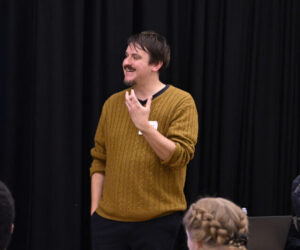
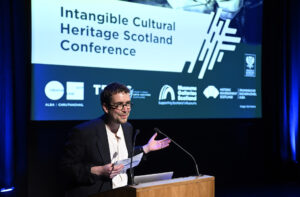
Following a welcome from TRACS director, Steve Byrne (pictured), we had an update from Phil Foxwood at the Department of Culture, Media & Sport, the lead on the UK Government’s ICH Inventory Programme. Phil outlined the upcoming process of engagement with the ICH inventory and gave audience members a preview of the draft website that will host the devolved UK inventories for Scotland, Wales, Northern Ireland, and England. We also heard a pre-recorded message from Angus Robertson MSP, Cabinet Secretary for Constitution, External Affairs and Culture, who underlined the Scottish Government’s support and appreciation for intangible cultural heritage in Scotland.
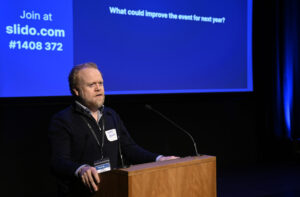
Delegates then heard from Poppy Jarratt, UNESCO Programme Officer for Perth and Kinross Council, who talked about how Perth was deploying its community assets, from kilns and photography suites to sustainable flax production for clothing, to incubator spaces for early career craft makers, to deliver on sustainability goals and cultural place-making.
The musician, broadcaster and ethnologist, Gary West, spoke about his personal memories and experiences of Perthshire traditions; he talked about piping traditions in Perth (including Borough support for the town piper via stipends/accommodation from the 16th to the 19th century) – and how the ‘carrying stream’ of tradition needs to be remembered in any discussion of ICH. He posed the question: how do we learn from the ‘love darg’ – or the traditional agricultural practice of giving, free of charge, a day’s labour to a member of the community in need – which was often accompanied by refreshments and entertainment? How does this spirit of participation, hospitality, charity, and place find a role in Scotland’s pursuit of UNESCO ICH safeguarding? How can we transcend the ‘listing’ process, and where can marginalized voices be found in this, as well as the distinctive voice of the land and knowledge associated with it?
if kilts are universally popular, visible, and clearly connected to Scotland… why is kilt making an endangered craft?
Marion Foster, founder of The College of Master Kilt Tailors, posed the question: if kilts are universally popular, visible, and clearly connected to Scotland… why is kilt making an endangered craft? Marion spoke eloquently about the importance of this traditional craft, the level of training and expertise required to produce a quality product, and the threats to it from ‘off the rack’ commercial alternatives. Marion spoke about the Living National Treasure programme or Ningen Kokuhō of Japan, where individuals who have attained a level of mastery are rewarded for their contribution to culture. Such schemes would be welcomed in Scotland. Marion spoke too of the challenges of kilt making/tailoring, especially around the viability of the profession in the 21st century. Attendees learnt about the work of the College, and how a mixture of online, written, and in-person training courses is taking steps to turn the tide.
Pat Ballantyne explored the fascinating world of traditional dance, and the relationship between published works by Francis Peacock (1805), Frederick Hill (c. 1840s), and the forms of traditional dance we have today. Pat talked about the spread of Scottish dance styles across the world as a result of migration, and how the Scottish Country Dance Society formalized some of these styles in the 20th century. There was a fascinating discussion about modern variants of dance from across the world; how societal and cultural change – such as the advent of amplified folk music in the 1960s and 1970s – brought attendant changes to dancing styles.
Josie Vallely, aka Quinie, spoke and sung about her experience of tradition and working in the traditional arts today. Inspired by the singing of Jeannie Robertson, Lizzie Higgins, and the poetry of Marion Angus, Josie’s approach blends experimental, personal renditions of traditional song, weaving in percussion, pipes, Scots and Gaelic, that ‘stands apart from tradition’ but is very much in the flow of it. She was keen to widen the sense of the term ‘living tradition’; eschewing the emphasis on collecting and freezing traditions – ‘not locking it down’ – and to support rather the ‘contexts where these songs are sung’. She spoke about the contemporary cultural landscape and its ‘competition for our attention’ – how ICH needs audiences and living contexts where people can experience it; in the past there was silence, space, darkness – places that were filled with song, stories, music. Similarly, residency-based approaches in the arts tend to parachute artists into communities temporarily – but what about artists that focus on their own place, traditions, and neighbourhoods? It feels, perhaps, that ICH can engender new ways of working but only if we are attentive to communities and their needs.
Next, Jess Smith recounted some amazing stories with poignancy, generosity, and often, laugh-out-loud hilarity. As the tale is often in the telling I won’t record everything she said here. It was fascinating and wonderful to hear of Jess’s own role in the preservation of the ‘Tinker’s Heart’ in Argyll, on the shores of Loch Fyne, near the junction of the A815 and the B839. Mostly forgotten, but known locally by some, the site was nearly lost on several occasions despite being significant to Traveler culture since at least the eighteenth century. In the 1920s, a local landowner had heard that the Heart was being tarmacked over and ordered the workmen to recover it; the black tar around the stones records the episode. Now, thanks to Jess’s campaign, the site is a Scheduled Monument – the only of its kind associated with Scottish Travelers – but a key factor in establishing its legal status was its ‘intangible cultural heritage’, the site as a cultural space, a meeting place, and as a place for marriage ceremonies.
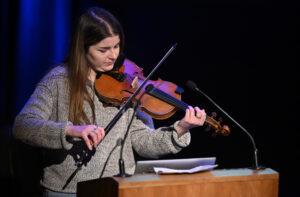
Museums Galleries Scotland’s very own Jacob O’Sullivan told us about the Manx organisation, Culture Vannin, and their plans for the Year of the Manx Language in 2026. Anyone with an interest in helping promote, collaborate, and celebrate Manx is invited to contact Cultural Vannin. It was a joy to hear about various Manx traditions – which Jacob avidly participates in – and to learn their linguistic and cultural similarities with Scots and Irish traditions, as well as their distinctiveness. Isla Callister performed some incredible Manx fiddle tunes and sung a traditional Hop Tu Naa song in Manx Gaelic (‘Hop-tu-naa, trol-la-laa’!).
David Lees, until recently part of the team at GalGael, told us about the history of the organisation and its role in the cultural life of the city. GalGael works on common tasks that generate community, such as practical projects and crafts which generate agency in the individual, giving them a meaningful role in the organisation and strong relationships with others. The relationship between radical politics, ecology, and crafts is tightly interwoven at GalGael – and is articulated in their vision:
‘A just Scotland
freed from scarcity,
violence and loneliness.
A welcoming Scotland
where our ties to one another,
our waterways and land
are revealed and revered.’
The connection between ‘our waterways’ and the work of GalGael refers back to the Statutes of Iona of 1609 (enforced in 1616), when King James VI of Scotland (and I of England) sought to break the authority of the Gaelic clan chieftains by reducing the number of boats they could own. Woodworking, and skills associated with the crafting of birlinnean, are a core part of GalGael’s work. More recently, GalGael’s founder Colin MacLeod, was a key figure in the Pollok Free State movement and the ‘No M77’ campaign and eco-camp (c. 1994 – 1996) that was set up in protest of the extension of the motorway. Its values revolve around a central aspect of tradition – the commons – the idea that we all have a share in land and that those rights need protecting.
The final talk of the day (before break out rooms and workshops) came from Rachel Blanche, Senior Lecturer in Arts Management and Cultural Policy at Queen Margaret University. Rachel presented early findings from a study commissioned by Creative Scotland – the first study of its kind in Scotland – which gathered real experiences of artists and how equality, diversity, and inclusion (EDI) is currently being addressed within traditional music, dance, storytelling, and other heritage practices. The research aimed to understand how inclusive the traditional arts sector is, and where barriers still exist.
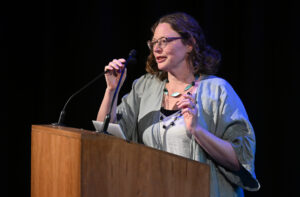
46 respondents and 15 stakeholder groups were surveyed. Overall, the responses were mixed: 29% of respondents felt that the traditional arts sector was accessible; 24% thought it was diverse; 37% thought it was inclusive. A general theme as it emerged from the research was the feeling of being ‘boxed in’ – artists felt like they were put in boxes and/or needed to tick boxes; some reported frustration at being used for ‘EDI optics’ and ‘tokenism’. Similarly, it was reported that ‘unspoken rules’, ‘hard to enter networks’, and ‘invisible barriers affecting culturally-new and neurodiverse artists’ were creating further barriers. Rachel covered a complex subject with clarity and generously shared the project’s research findings with the audience. We look forward to learning more from this important survey when it’s published.
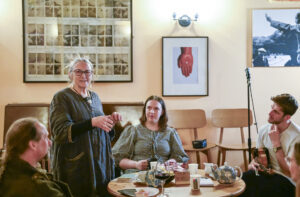
Following either a museum visit or a workshop, many flocked to Osteria Bau Bau in the city (a great venue with fab victuals) to enjoy an informal ceilidh led by the super talented Claire Hewitt, Charlie Stewart, and Ellie Beaton; it was a time of great craic and conversation, furnished by the talent of conference delegates in the form of BSL storytelling, poems, ballads, and great music. Huge thanks to all the organisers and speakers. I’m looking forward to the ICH Conference in ’26 already.


