Football Memories: from pilot scheme to national programme
The Scottish Football Museum started Football Memories in 2009 with a simple idea: to tackle social isolation by setting up reminiscence groups.
Curator Richard McBrearty reflects on how Football Memories has grown from an MGS-funded pilot to a national programme which benefits thousands of people right across Scotland.

Project overview
Football Memories aims to support people who are experiencing social isolation. Social isolation comes in many forms – one being dementia, which is core to the project.
Our role at the museum is to create resources that enable groups to operate under the partnership that we’ve set up. We deliver training to volunteers, who then run Football Memories sessions in their communities.
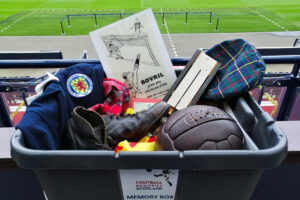
Groups meet on a drop-in basis. They use a variety of tools which we’ve provided, including packs of Football Memories cards, audio, visuals, museum tours, and a dedicated website.
The project has developed considerably since 2009, when we got funding from MGS to run the pilot. It’s now a national network of around 5,000 people in nearly 600 groups across Scotland. The large majority of these are in care homes or daycare centres. We also have a number of NHS hospitals that run groups, as well as 90 or so community-based groups.

Building powerful partnerships
Create the space for strong ideas
Football Memories was suggested at the very first meeting of the Scottish Football Heritage Network, which was established as a requirement for our museum’s Accreditation status.
A representative from Falkirk FC had been meeting with elderly football fans to show them old images of Brockville Stadium. They put out the idea that if it works in Falkirk, surely it must work in Ayr. And if it works in Ayr, then it must work in Aberdeen too: and shouldn’t we use this network to do something about it?
Connect with experts
We got MGS funding to set up a one-year pilot project for Football Memories in 2009. We hadn’t worked on the subject of dementia before, so it was a very tentative process. We connected with care homes and groups with experience of working in this area. We brought in Glasgow Caledonian University to evaluate the pilot, and the results were hugely positive: this encouraged us to continue with Football Memories.
The game changer after the pilot was that Alzheimer Scotland saw the power and potential of our work and decided to join the project as full partners. They’d been offering us advice during the pilot to ensure that our groups are dementia-friendly.
Facilitate feedback and encourage interactions
One of the best things we ever did was the 2018 Football Memories National Convention. We brought in 180 people from all over Scotland who were involved in the project, as well as speakers such as the Care Inspectorate. Some people run the groups on their own, so they find it really rewarding to get together and talk about their experiences.
The Scottish Football Museum provides this steer, as we go in for funding and provide some resources. But the beauty of Football Memories is that it’s not rocket science.
Richard McBrearty, Curator at the Scottish Football Museum
The role of the museum
We co-ordinate the project
Football Memories sessions are something that Network members can organise locally. All that’s needed is a little bit of guidance. The Scottish Football Museum provides this steer, as we go in for funding and provide some resources. But the beauty of Football Memories is that it’s not rocket science.
We connect experts and information
Another benefit of a national network is that our museum doesn’t have all the answers. We don’t have all the objects our groups might need. If you’re an elderly Aberdeen football fan who moved to another part of Scotland, your group might not have the right images or information. We’ve created a national digital archive of images which means that a facilitator can go in and do a keyword search for all the Aberdeen images. This personalises the reminiscence so that the person from Aberdeen is still very much a part of the community-based group.
We train up volunteers to deliver sessions
This includes setting clear expectations, providing resources and reassurance. We’re a support mechanism. We switched to online training as the project grew, but used to deliver our training in person.
Typically, the volunteers at these in-person training sessions were split down the middle: 50% from the care sector, and 50% from football communities. So to break the ice while introducing the concept of Football Memories, we shared cards from a side project called Screen Memories, and asked everyone to pick their favourite actors and movies. We stumbled into this technique; there’s a real learning curve to projects like this. But that’s what it’s all about.
Scaling up your project
Focus on resilience and sustainability
We didn’t have a grand strategy for Football Memories: in 2010, we didn’t know where we were going to be in 10 years’ time. But one thing I’ll say about the project is that it’s resilient. We could stop working tomorrow and those groups would still be running.
We’re a small team: I work on Football Memories part-time, and we have a part-time administrator for the project who makes sure that our contacts are up-to-date. So we have to focus on how to deliver a national project without getting carried away.
In the early years, our Chair Robert Craig was always very careful to make sure we didn’t get carried away or bite off more than we could chew. He was always of the opinion we need to test what works and roll it out in a way that won’t unravel.
Close partnerships unlock opportunities
By working with Alzheimer Scotland, we had access to a national network of groups. So this was an obvious starting point for scaling up the project.
As a football museum, we have access to people running the game, and to clubs across Scotland. The Scottish Football Heritage Network that we set up was brilliant for us as we immediately gained access to historians and people connected with football clubs.
We worked to create relationships by speaking individually with clubs, community trusts, and – more recently – care homes. We now have 445 care homes registered with Football Memories: that’s a huge number which would have overwhelmed us 10 years ago.
Digital skills can support growth
When the project started, we were focused on physical resources and in-person training. The COVID pandemic really made us think about how we deliver our support; now, with a focus on digital, we’re able to easily manage much larger numbers of groups and volunteers.
Measuring impact
Collect a wide range of insights
Our Football Memories National Convention in 2018 was attended by care home staff, NHS employees, football volunteers, and club officials. We asked them a number of questions, including:
- If we had a magic wands, what would help your groups?
- What is your group doing?
- Are you facing any challenges?
And the feedback was amazing; we learned so much. There were so many brilliant ideas, usually grassroots. We’re always learning from NHS practitioners, care home staff, and community groups about what works and what doesn’t.
Qualitative feedback is essential
We interviewed people who were delivering reminiscence sessions, as well as the carers of session participants. It’s powerful testimony: for example, the wife of one of the participants said something to the effect that each time she goes to Football Memories, she brings a sad old man with dementia and takes home her husband – because it enabled his personality to come through.
Become an advocate by gaining first-hand experience
Sometimes evidence is anecdotal; sometimes you need to actually experience it for yourself. Working as a volunteer for Football Memories, I’ve seen what it can do. You’ve got to listen to people at the grassroots, running the groups.
Project outcomes
It has raised our profile
We concentrate on Football Memories because we really punch above our weight: we currently have 594 registered reminiscence groups across Scotland.We’ve also built international connections by helping to set up Football Memories projects in Brazil and the Netherlands. Their researchers attended our 2018 convention, and were blown away. It has really put us on the map, which is great for a small museum from a small country.
It has had a national impact
Almost all Council Authorities have signed up to offer Memory Scotland groups in their libraries now. By working with libraries and local history collections, Football Memories is connected to archival images of High Streets, factories, dancehalls – because that’s all part of the reminiscence project, too.
It has strengthened our focus on the visitor experience
Football Memories is now first and foremost in our thoughts. When we put on an exhibition, we ask: “How does that benefit our groups?”. As objects are a memory trigger, we also offer all our groups free tours of the museum. So it’s important for us to make our venue as assessable as possible.
It has supported new approaches to reminiscence
This includes VR headsets and sound. We’ve been working with a PhD student who has created audio-based resources for our groups, and we now close the museum on Thursday afternoons so that people with dementia can use our VR hub and explore the rest of the museum in a tranquil setting.
Additional information
Email: For more information about Football Memories, contact Richard McBrearty.
Visit: Find out more about the Scottish Football Museum on their website.
Read: The Scottish Football Museum is a member of the Sporting Heritage Subject Specialist Network. Sporting Heritage created a Memories Handbook, which advises on reminiscence work in heritage settings, in 2021.