Diversity on display: highlighting LGBTQ+ histories
National Galleries of Scotland collaborated with historian Ashley Douglas to develop a display about Marie Maitland, a 16th century poet whose works explored themes of same-sex attraction.
For our series on LGBTQ+ inclusive interpretation, Senior Curator Kate shares how they found creative ways to showcase the story of a figure whose appearance has been lost to history.

The project
In 2021 the National Galleries of Scotland (NGS) were approached by the historian, translator, and consultant Ashley Douglas. Ashley was keen to share her research which focusses on the 16th-century Scottish poet Marie Maitland (late 1540s–1596). Ashley has been researching Maitland’s biography and literary output with a particular focus on uncovering the poet’s voice through the Maitland Quarto (1586) manuscript, a collection of poems that includes several Sapphic poems, including one known as Poem 49.
Written in Scots by a female author, which Ashley has identified as Maitland herself, the poem speaks of the love between two women. Two short lines from the poem are particularly evocative:
Thair is mair constancie in our sex
Then euer amang men hes bein
(There is more constancy in our sex, than ever among men has been)
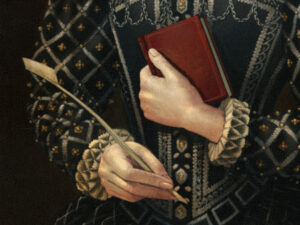
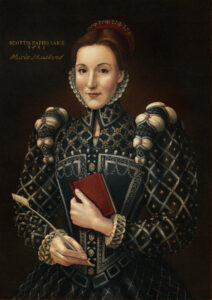
While portraits of two of Maitland’s brothers— William and John Maitland — survive from their lifetime, she was visually unrepresented. Keen to give Marie Maitland her rightful place in Scotland’s history, Ashley commissioned an illustrator to create an imagined portrait of the poet in a 16th-century style. Maitland’s facial features were influenced by the surviving portraits of her brothers, while her clothing, accessories, and pose reflect those found in portraits of Scottish noblewomen from the period.
Around the same time I was developing a small display at National Galleries Scotland: Portrait, focussing on the individuals who lived and worked in Scotland under the reign of King James VI, titled James’s People. NGS had also committed to prioritise the representation of artists and sitters with protected characteristics in the collection and programme and ensure that interpretation is reviewed through the lens of equality, diversity, and inclusion. The approach from Ashley was therefore timely.
I met with Ashley to discuss her research, the upcoming display and how Maitland’s story could be incorporated into the display concept. The ambition was not only to uncover Maitland’s contribution to 16th-century Scottish culture, but also to use her poetry and voice to highlight that same-sex relationships and self-identified LGBTQ+ people were very much present in early modern Scotland, despite their relative absence in historical records.
As well as working with Ashley on the in-gallery interpretation we made the decision to translate the Maitland interpretation into Scots, reflecting the language that she, and indeed King James, spoke and wrote in. To increase accessibility for our visitors Ashley translated the text into modern Scots, rather than 16th-century Scots.
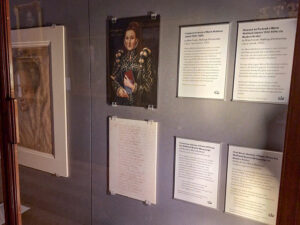
The James’s People display opened in Spring 2023. Alongside the imagined portrait a reproduction of the first three stanzas of Poem 49 from the Maitland Quarto, was included, accompanied by interpretation. Ashley was also commissioned by NGS to write a blog post on Maitland which gives a deeper dive into her life and place within LGBTQ+ histories.
We’re very thankful to Ashley for generously sharing her time and research for this collaboration. The visitor feedback has been overwhelmingly positive and our audiences have been fascinated to learn more about Maitland’s story and achievements, while the imagined portrait has brought to life a visual representation of this significant, yet unsung Scots woman. Her story has garnered interest from school and community groups who have visited the gallery specifically to see the portrait. Due to the display’s popularity the Maitland portrait and related interpretation remain on view in Room 6 at the Portrait gallery.
Further information
Read: With My Own Hand, a biography of Marie Maitland by Ashley Douglas.
Research: The Maitland Quarto Manuscript (PL1408) is in the collection of the Pepys Library of Magdalene College, University of Cambridge.