
Working with photographers and models
Professional photography can transform your marketing and attract new audiences to your museum or gallery. This guide will help you identify your needs, build a brief for photographers, and plan a photoshoot.
Identifying a need
Museums should have and use up-to-date photos which showcase their collections, spaces, and the visitor experience.
High-quality photos can help you attract visitors and achieve your marketing goals. They can improve your website, social media, Google Business Profile, promotional materials, and signage. They can promote events, support projects, and enhance press releases.
Read our marketing toolkit and social media toolkit for more information on how photography can support your objectives.
Consider how other museums and local attractions are using photography to promote themselves. Do they succeed in portraying the venue as an attractive, entertaining, and inspiring place to be? What photos are you drawn to, and why? This will help you to identify any gaps in your own museum’s photography.
Writing a brief
Once you’ve identified a need for photography, you should write a brief which contains all the essential information for any photographers you hire. This process will also help you to figure out exactly what photos you want.
Here are some suggestions on how to build your brief.
Outline
- Explain exactly what you need from the photographs. Do you want photos of people exploring the galleries at your museum? People walking in and out of the museum entrance, browsing your shop, and playing with interactives? Attractive interiors or object details?
- Tell the photographer about the details of this work. This can include information about the subject of the photos: for example, the use of models, young people, live animals, or objects which require specialist handling.
- Share the specifics of the job, including hours of work, whether you require photo editing, and what file formats you want.
Brand identity
- Your photos should reflect the brand identity of your museum or gallery. Explain this identity in your brief, and describe how you want your photos to look and feel. Should they be bright and fun, or serious and reflective? Should they be calm or energetic? You might decide to include examples of photography that you’re inspired by and hoping to replicate, and examples of past photography that you’re wanting to move away from.
Target audience
- Who are you trying to attract to your venue? Think about the things they would like to see. Young families may want to see photos of interesting interactives, accessible entrances, and places to play and eat. Teenagers may want to see relaxed spaces where they can spend time together. Older adults may want to see a bright and friendly café. The wants and needs of your target audience should always inform your photography.
- Also consider if any demographics are currently underrepresented among your visitors. Featuring members of these groups in your photography may convince wider audiences to imagine themselves in your venue. Underrepresented groups may include disabled people, LGBTQ+ people, or people whose ethnicities are minoritised in Scotland. Photography which features a diverse range of people may also help to attract international visitors. If you’re aiming to attract more diverse audiences, you must also ensure that your venue is a safe, welcoming, and accessible space: for more information on this topic, visit our advice guide on diversifying audiences.
Purpose
- Explain how you plan to use the photos. For example, on social media, your website, or on printed materials such as pamphlets, posters, or banners. Providing this information will help the photographer with the composition of their photos.
- If you plan to release the photos to the public domain by making them open-access, you will need to make this clear to the photographer and obtain their written consent to do so.
Location and access
- Provide a simple description of the locations that the photographer will be using. This should include information on the accessibility of the venue and the availability of parking.
- For photography which may require additional equipment – such as object photography – be mindful of available space, light levels, and access to charge points.
- For photography of interiors, advise on the lighting levels of each space and make it clear if any areas contain any light-sensitive objects.
Timeline and budget
- Photographers will appreciate even a basic outline of your key dates and available budget.
Case study
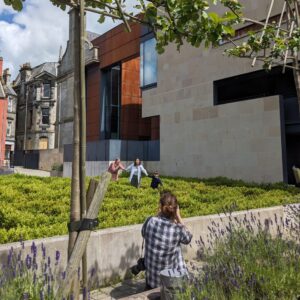
In summer 2024, MGS hired photographer Ryan McGoverne and three models for a half-day photoshoot at Dunfermline Carnegie Library & Galleries and Carnegie Birthplace Museum. Our objective was to spotlight museums as welcoming spaces for LGBTQ+ families. This closed some significant gaps in our image library and resulted in a broader range of marketing materials for the museums involved.
Our plans focused on indoor photography, but we adapted this on the day to account for the good weather. We also factored in a mid-morning break for snacks, which kept everyone’s energy up and gave the models and photographer some more time to build rapport.
Hiring a photographer
Search online for local photographers. Look on the websites of attractions which are similar to your venue to see what photographers they are using.
Many photographers have their own websites. Review their portfolio: does the photographer’s style match your brand? Do they have experience of photographing museums, galleries, and other indoor environments? Do they have experience of working with models?
Once you’ve identified some potential photographers, send them your brief and request a quote. To get an idea of the costs associated with hiring a photographer, the Scottish Artists’ Union offers recommended rates of pay based on Fair Work principles.
You may also wish to chat with the photographer about their preferred working methods, the level of involvement you’ll have on the day of the photoshoot, and the specifics of your brief.
Once you’ve selected a photographer to work with, you should enter into a formal written agreement with them. The photographer may already have a template contract which both parties can work together to adapt.
Working with models
If you’re planning to stage photos which feature people, you’ll need to find some models. Make sure to select models which reflect your target audiences.
If you decide to pay for models, organise this through a reputable casting agency. Hiring a model may cost in the region of £200 to £300 for half a day of work. To identify the right models, you can either provide the agency with a brief or search through their rosters yourself. We advise that you work with an agency based in Scotland to avoid high travel costs for the models.
You may choose to recruit friends or family members to model for you. Be aware that, unlike professional models, they may not have experience of being in front of cameras or working with photographers.
You should provide your models with some basic guidance about what clothing to wear. We suggest that models avoid complex patterns, big logos, or recognisable brands as these can be distracting and difficult to photograph.
It’s very important that you acquire written consent from the models to use them in your photography.
On the day of the photoshoot
Schedule for your photoshoot to take place on a day when your venue is closed to the public. If this isn’t possible, then make sure to advise visitors that a photoshoot is taking place.
If you’re arranging outdoor photography, plan for bad weather. Do you have any back-up options?
Take time to make the photographer and models feel at ease in your venue, and with each other. It might take them a bit of time to warm up.
Offer the photographer and models refreshments and time for breaks.
If you’re working with models, explain the dynamic for the photos. Are they supposed to be family, or friends? How are they supposed to feel?
Gently advise models and the photographer to set realistic expectations in photographs by sticking to your museum’s etiquette: for example, not being photographed in out-of-bounds areas, or touching objects that shouldn’t be touched.
Conduct risk assessments to ensure that everyone on-site remains safe throughout the photoshoot.