World's oldest football crosses Atlantic for World Cup appearance
The 16th-century ball, held at The Stirling Smith Art Gallery & Museum, is set to travel to Miami for a special exhibition before attending the Brazil v Scotland match on 24 June.

Today, the Stirling Smith hosted a public farewell event to celebrate the start of the football’s journey to Miami where it will be displayed at the Coral Gables Museum as part of their headline exhibition, Diplomacy and the Beautiful Game: From Scotland to Brazil to Haiti. It will be on display to the public from 20 to 26 June. During the visit, the ball will also attend the World Cup match between Brazil and Scotland on 24 June.
Members of the public, school children, partners, diplomats, and local politicians attended today’s event to mark the send off.
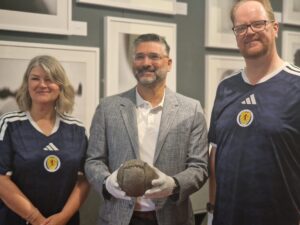
Caroline Mathers, Director of the Stirling Smith Art Gallery & Museum, said:
“This is one of the most exciting moments in the recent history of the Smith. The world’s oldest football belongs to Stirling, and to see it travel to the United States to take its place alongside the world’s greatest football tournament is a source of enormous pride. It is a reminder that a small, free-to-enter museum in central Scotland holds objects of genuine international importance – treasures that tell the story of our nation to the world.
Lucy Casot, CEO of Museums Galleries Scotland, said:
“The world’s oldest football is an extraordinary object that connects Scotland’s rich sporting heritage with a game followed and loved across the globe. This international loan is a fantastic opportunity to showcase one of the most significant items in the Stirling Smith’s collection and to share an important part of Scotland’s story with new audiences. As the ball takes its place alongside the world’s best players and most passionate fans in the United States, it is a powerful reminder of the global reach of Scotland’s collections.”
The project is a partnership between the Stirling Smith Art Gallery & Museum, the Brazilian Consulate in Scotland, the Consulate General of Brazil in Miami and Coral Gables Museum, with funding support from Banco do Brasil.