
Workforce for the Future evaluation
Introduction
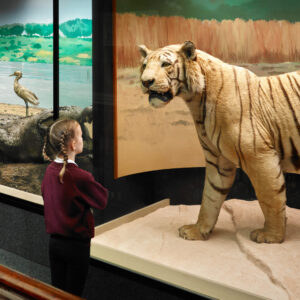
The Workforce for the Future project involved working in partnership with museums, Developing the Young Workforce (DYW) and schools on the Scottish Index of Multiple Deprivation (SIMD).
The project supported P5 – S2 pupils to work with their local museum on projects that introduced the diversity of job roles within the museum sector while developing employability skills. It was delivered across all 32 council areas in Scotland over three years. Pupils created various outcomes, from exhibitions and audio tours to school resources and shared experiences.
Whilst this project had a national remit, we valued the uniqueness of each region across Scotland and were committed to ensuring that each project had local relevance.
About the project
Within the project there were three strands:
Workforce for the Future: Pilot
This project began with pilot projects for P5, P6 and P7 pupils.
Workforce for the Future: Primary Schools
Museums, schools and Developing the Young Workforce worked together to provide young people with the opportunity to learn more about how local history is shared, whilst exploring the museum as a workplace. Through this strand primary school pupils developed their employability skills, learnt about the diversity of job roles in the sector, and increased their confidence and creativity, whilst museums were seen as desirable places to work and visit. This strand was funded by Art Fund.
Workforce for the Future: Secondary Schools
S1 and S2 pupils co-created a resource with their local museum, learning about the diversity of job roles in the sector and increasing their employability skills. Working with S1 and S2 pupils who are pre-subject choices allows for flexibility in the curriculum, which enabled effective participation in this project. This strand was funded by Postcode Culture Trust.
Impact of the project
Key highlights from the project are:
- Working with local DYW co-ordinators supported schools to connect with their local museum.
- Participating museums could access up to £2,500 to support their engagement with local schools.
- MGS commissioned Daydream Believers to create the Marseum learning resource which has engaged over 4000 pupils across Scotland.
- The secondary school strand engaged pupils across 8 different council areas in Scotland.
- The primary school strand reached schools across 21 different council areas in Scotland.
“I loved the project, I have improved in sharing opinions and openly talking about any ideas.” “I like the fact that we were able to plan our own thing.” “A new thing I have learnt in the museum is we need teamwork to keep everything together. I have learnt to talk and help plan the escape room with positive feedback.”
Pupils at Dunbar Grammar
“Making the connection with hard-to-reach pupils and engaging them in museum work has been the highlight of the project for us. We’re delighted to already be working on follow up projects with them which would never have been possible without the support of MGS and DYW.”
Dumfries and Galloway Council Museums
“In the Marseum project we enjoyed being able to come up with ideas of our own and then bring them to life. Presenting was really enjoyable because us and the judges all got involved. Overall we really loved the Marseum project and it has led us to pick Creative Thinking in Design & Technology. We hope to get other opportunities like this in the future!”
Inverclyde Academy Pupil
Resources
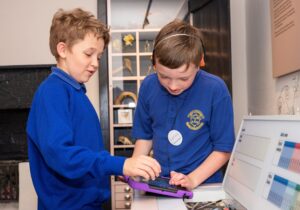
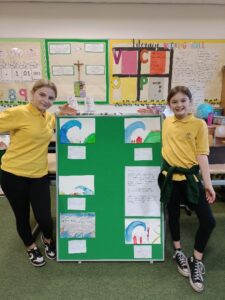
We collaborated with Daydream Believers to create a free, accessible, learning resource for schools and museums to support Workforce for the Future projects. The Marseum learning resource was created to develop young people’s skills while supporting pupils to learn about museums and galleries. The resource is free and available for anyone to download, use, and run their own project.
Lessons learned
- Legacy work is ongoing. Long term relationships have continued between schools and museums across Stirling, Oban, Glasgow, Edinburgh, Borders, Orkney, Shetland and more!
- Many young people have never visited or are unaware of their local museum, showing the need to increase engagement with SIMD areas.
- Flexibility is key; each partner could shape Workforce for the Future and Marseum to fit their needs, encouraging creativity and collaboration through challenges, leading to deeper learning for pupils.
- Transport remains a major barrier. Funding helped museums connect with previously inaccessible schools.
- Marseum, a free national learning resource, has been vital in removing barriers and highlighting museums’ role in skills-based learning aligned with Curriculum for Excellent and Education Scotland goals, with partner schools embedding the project in their curriculum for future year groups.
Participants included:
• Aberdeen Archives, Gallery & Museums and Hanover Street Primary School
• Argyll and Sutherland Highlanders Museum and Beancross Primary School
• Baird Institute and Robert Burns Academy Supported Learning Centre
• Brodick Castle and Country Park and Brodick Primary School
• Brodick Castle and Country Park and Arran High School
• Castle House Museum and Clyde Valley High School
• City Art Centre and Pirniehall Primary School
• Cromarty Courthouse Museum and Cromarty Youth Café
• David Livingstone Birthplace Museum and David Livingstone Memorial Primary School
• Dumfries & Galloway Museum Service and North West Community Campus
• Dunkeld Chapter House Museum Trust and the Royal School of Dunkeld
• Dunollie Museum, Castle and Grounds and Oban High School History Club
• Fyvie Castle and Fyvie Primary School
• Glasgow School of Art and Barrhead High School
• John Muir’s Birthplace and Dunbar Grammar School
• Kinloch Historical Society and Sgoil nan Loch
• Kirkintilloch Heritage Centre and St Ninian’s High School
• National Mining Museum Scotland and St David’s High School
• North Lanarkshire Heritage Centre and Clyde Valley High School
• Paxton House and Eyemouth Primary School and Berwickshire High School
• Robert Burns Birthplace Museum and Kincaidston Primary School
• Scottish Maritime Museum and Dumbarton Academy
• Scottish Fisheries Museum and Mountfleurie Primary School
• Scottish Football Museum and Hollybrook Academy
• Shetland Museums & Archives and Mid Yell and Beltasound Junior High Schools
• Stromness Museum and Dounby Primary School
• Talbot Rice Gallery and Clovenstone Primary School
• University of Stirling Art Collection and St Mungo’s Primary School
• Watt Institution and Inverclyde Academy
• Wee Museum of Memories and West Calder High School